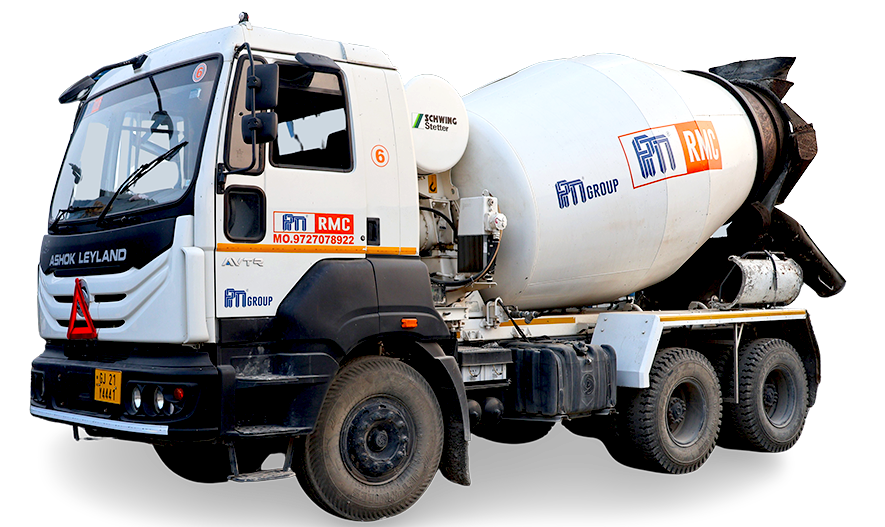

A factory floor is one of the few parts of a building that is used hard every single day. Forklifts turn on it, racks press into it, machines vibrate on it and pallets are dragged across it. When the floor cracks, dusts or curls at the joints, the cost is not only repair. It is downtime, damaged stock and slower operations. Choosing the right RMC for industrial flooring is therefore a production decision as much as a construction one. This guide covers how to pick the grade, what workability the finishing crew needs, and how to plan the pour so the floor performs for years.
Why Industrial Floor Concrete Is Different
Industrial floor concrete is judged on more than cube strength. A slab can pass every 28-day test and still fail in service if the surface is weak, the joints are poorly cut or the concrete was finished at uneven setting times. Wide, thin and exposed slabs are also more sensitive to shrinkage, bleeding and curing.
Three things decide how a floor performs: a grade that suits the loads, a mix that finishes consistently, and a pour that runs without interruption. RMC helps with all three, because every truck is batched to the same design and delivered on a planned schedule.
Choosing the Grade of RMC for Industrial Flooring
The final grade should come from the floor design, which considers wheel loads, rack leg loads, sub-base strength and slab thickness. The table below gives typical starting points that consultants and buyers often use when discussing factory flooring concrete with a supplier.
| Floor Use | Typical Grade Range | What to Watch |
|---|---|---|
| Light assembly, packing and storage | M25 to M30 | Surface hardness and dust resistance |
| Warehouses with forklifts and pallet racking | M30 to M35 | Joint edges, rack leg point loads and flatness |
| Heavy industry, logistics hubs and loading bays | M35 to M40 | Impact, heavy wheel loads and abrasion |
| Chemical, food or cold storage units | As per consultant design | Exposure conditions and special admixtures or toppings |
A higher grade alone does not guarantee a better floor. A very rich mix can shrink more and crack if curing is poor. The right answer is the grade the design needs, produced consistently.
Workability That Suits Floor Finishing
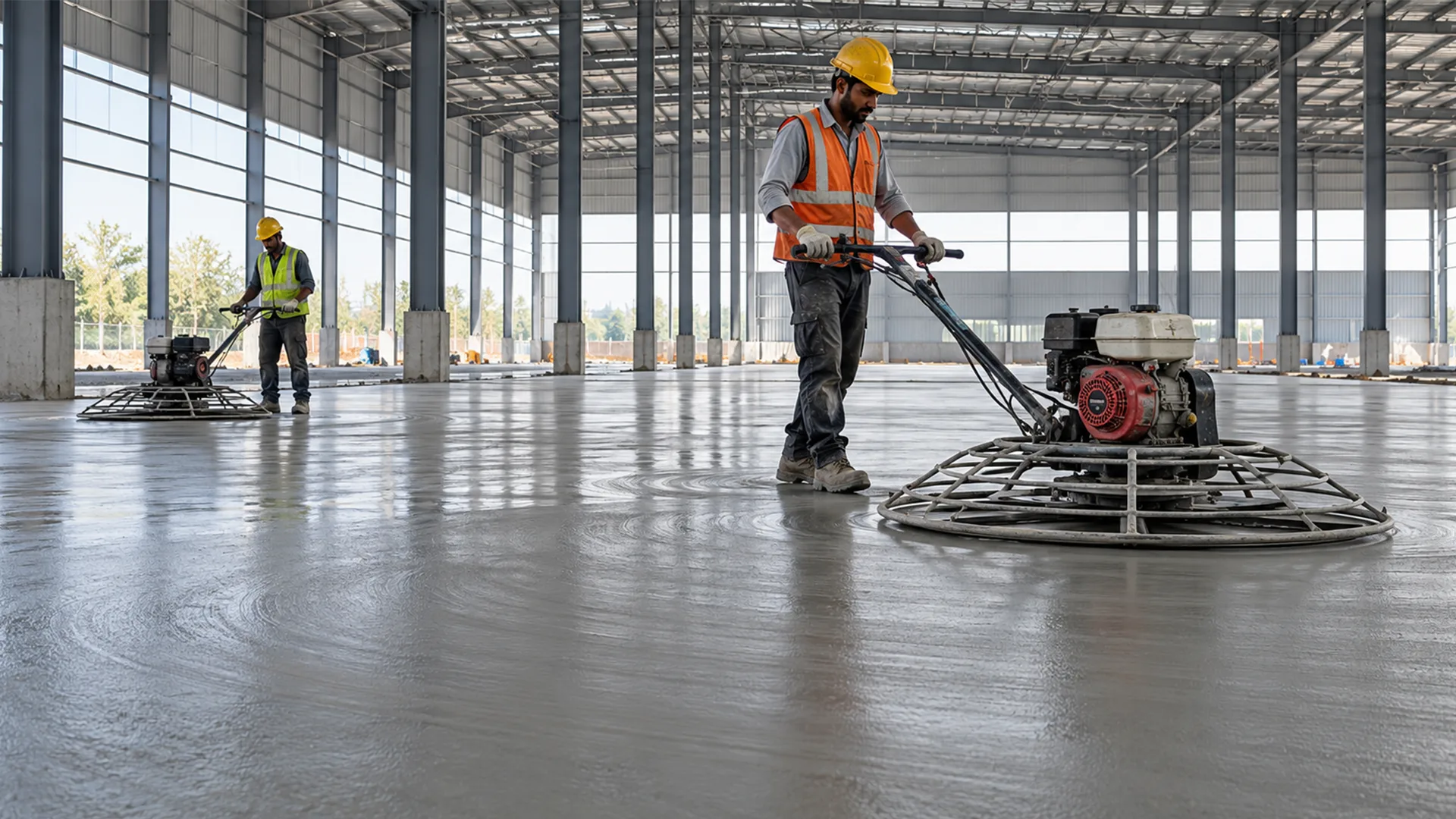
Workability is where many floors go wrong. The finishing crew needs concrete that spreads easily, levels without heavy vibration, and reaches the power-troweling stage at a predictable time. Floor contractors commonly work with a slump of roughly 100 to 125 mm at site, but this should be agreed with the floor contractor and consultant before the pour.
Consistency between trucks matters even more than the slump value itself. If one truck sets faster than the next, part of the bay is ready for troweling while the rest is still soft, leaving visible patches and a weaker surface. This is why adding water at site to "loosen" a stiff truck is so damaging. It weakens the top layer exactly where the floor takes the most wear.
Aggregate quality plays a part too. Well-graded, cubical 20 mm aggregate and clean sand reduce bleeding and make the surface easier to close. Excess fines or flaky stone increase water demand and the risk of surface dusting.
Fibres, Hardeners and Admixtures in Concrete for Warehouse Floors
Concrete for warehouse floors often includes steel or synthetic fibres to control cracking and, in some designs, to reduce conventional reinforcement. A dry-shake or surface hardener can be applied during finishing to improve abrasion resistance. Admixtures should be selected for a stable setting time rather than maximum flow. Tell your RMC supplier about all of these early, because fibre dosing and admixture choice affect the mix design and the batching sequence.
Pour Planning Checklist for RMC for Factory Floors
A floor pour is a timed operation. Before confirming the date for RMC for factory floor work, make sure the following are in place:
- Sub-base compacted, levelled and tested, with the membrane laid where specified.
- Bay layout, joint positions and pour sequence agreed with the consultant.
- Grade, slump at site, fibre dosage and admixture type confirmed in writing with the RMC plant.
- Hourly delivery rate matched to the floor crew's laying and finishing speed, with buffer trucks.
- Pour start time set for early morning or night to avoid peak heat and traffic.
- Finishing crew, power trowels, saw-cutting equipment and curing materials ready on site.
- Slump checks and cube sampling planned for each truck or as per the quality plan.
Joints, Curing and the First Few Days
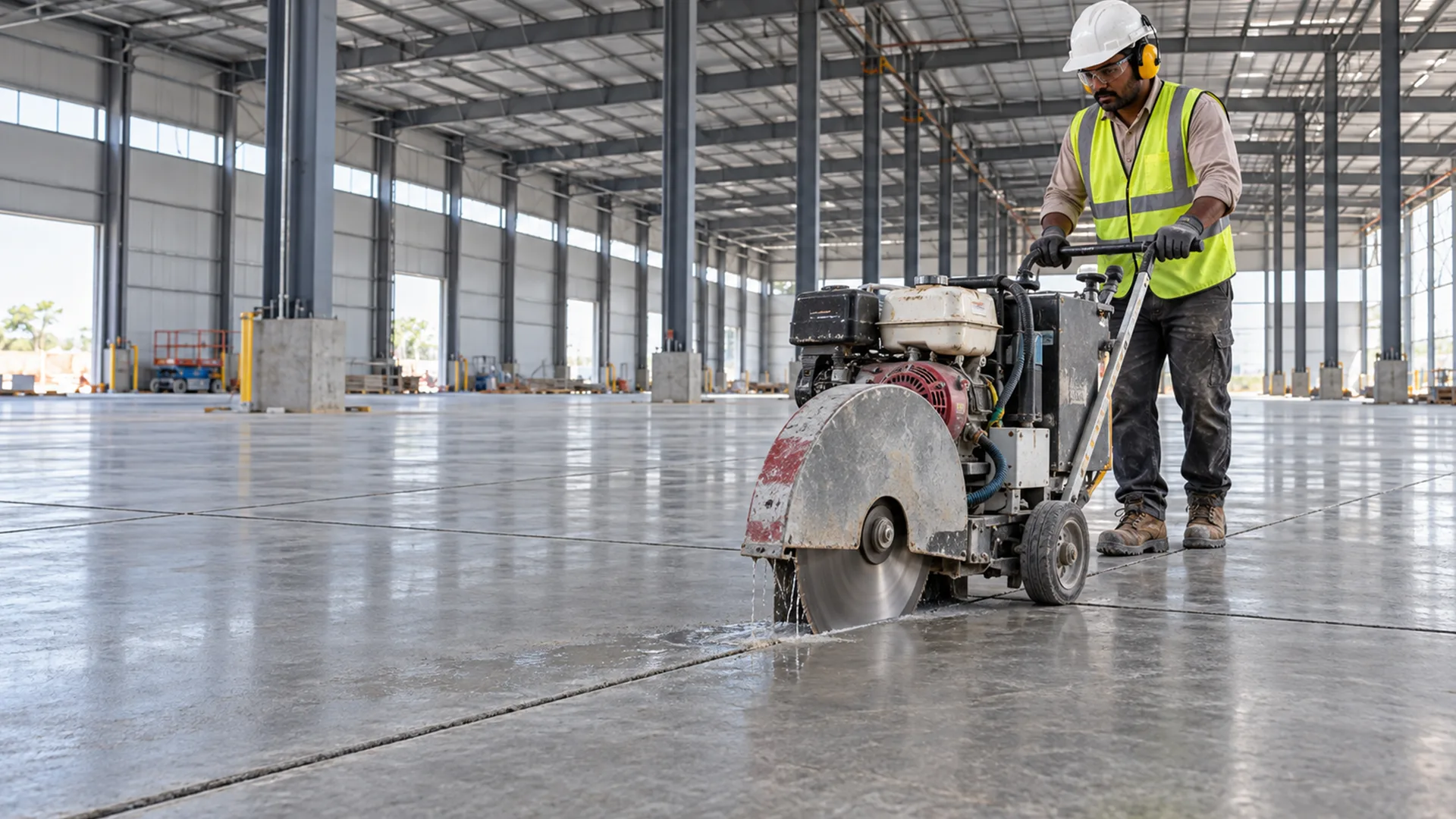
Contraction joints should be saw-cut as soon as the surface can take the saw without ravelling, typically within the first day. Cutting late is one of the most common reasons for random cracks across a new floor. Curing should start immediately after finishing and continue for the period set in the specification, using wet curing, curing compound, or covered membranes. Keep forklifts and heavy traffic off the slab until the concrete reaches the strength the designer has specified.
Industrial Concrete Flooring in India: The South Gujarat Context
Industrial concrete flooring in India faces two local challenges: heat and pace. In South Gujarat, industrial zones such as Sachin, Hazira, Palsana and Kim are expanding fast, and many floors are poured under tight handover dates in high temperatures. Hot conditions shorten finishing time and increase the risk of plastic shrinkage cracks, so night pours, cooler mix temperatures and early curing make a measurable difference.
Why PM RMC for Industrial Projects
PM RMC is part of PM Group, which has almost three decades of experience in construction materials across South Gujarat. Its aggregates come from Patel Aggregates & Sand within the same group, where three-stage crushing produces the cubical aggregate that helps floor concrete finish cleanly. ERP-based tracking from production to dispatch records batching and dispatch details for every truck, which supports the consistency a floor pour depends on.
Conclusion
A good industrial floor is built on three decisions: the right grade for the loads, a mix that finishes consistently, and a pour that is planned around the crew, the weather and the supply. Getting RMC for industrial flooring right at the planning stage costs far less than repairing a floor that is already in use.
Planning a factory, warehouse, or industrial shed floor in South Gujarat? Share your floor area, design grade, and pour schedule with PM RMC, and our team will help you plan the mix, delivery rate, and pour sequence.
Project Enquiry
If you are looking for dependable paving solutions for your next construction or infrastructure project, connect with PM Group to discuss your project requirements and identify a suitable paving solution.
Talk to Our Team