
On most sites in Surat the argument stops at the rate per cubic metre. Site mixed concrete looks cheaper on that one number, so it wins the conversation. The number that matters is what the finished structure costs once cement wastage, labour, storage, rework and schedule slippage are added back in.
Two ways to batch the same M25
- Cement counted in bags
- Sand and aggregate measured by farma, filled by eye
- Water added by the operator's judgement
- Aggregate moisture not measured, not corrected
- Record of the batch none
- Cement weighed to the mix design
- Sand and aggregate weighed on load cells
- Water dosed to a fixed water cement ratio
- Aggregate moisture tested, water corrected each batch
- Record of the batch printed slip with every load
Where site mixing loses control
Site mixing batches by volume. Cement goes in by the bag, sand and aggregate go in by farma, and the water goes in by the operator’s judgement. Aggregate moisture changes through the day and nobody adjusts for it, so the water cement ratio moves pour to pour. That variation is why nominal mixes are permitted only up to M20 under IS 456. Anything above that needs a design mix, and a design mix needs weigh batching to mean anything.
The cement you cannot see on the bill
Speed changes the whole schedule
A site mixer with a full labour gang manages roughly 5 to 8 cubic metres a day. A transit mixer and pump place 30 to 60 cubic metres an hour. A slab that takes four days of site mixing, with cold joints at every stoppage, becomes one continuous monolithic pour. Shuttering comes off sooner, the next floor starts sooner, and the interest on the project clock stops running.
Side by side
| Parameter | Site mixed concrete | Ready mix concrete |
|---|---|---|
| Batching | By volume, using farma or head pan. Cement bags counted, sand and aggregate estimated by eye | By weight, computer controlled batching plant with printed batch record for every load |
| Water control | Water added by judgement of the mixer operator, changes through the day | Water cement ratio fixed in the design mix and held to it, corrected for aggregate moisture |
| Achievable grade | Nominal mixes are permitted only up to M20 under IS 456 | Design mixes from M20 to M60 with trial mix backing |
| Output | Roughly 5 to 8 cubic metres a day with a site mixer and labour gang | 30 to 60 cubic metres an hour with a boom or line pump |
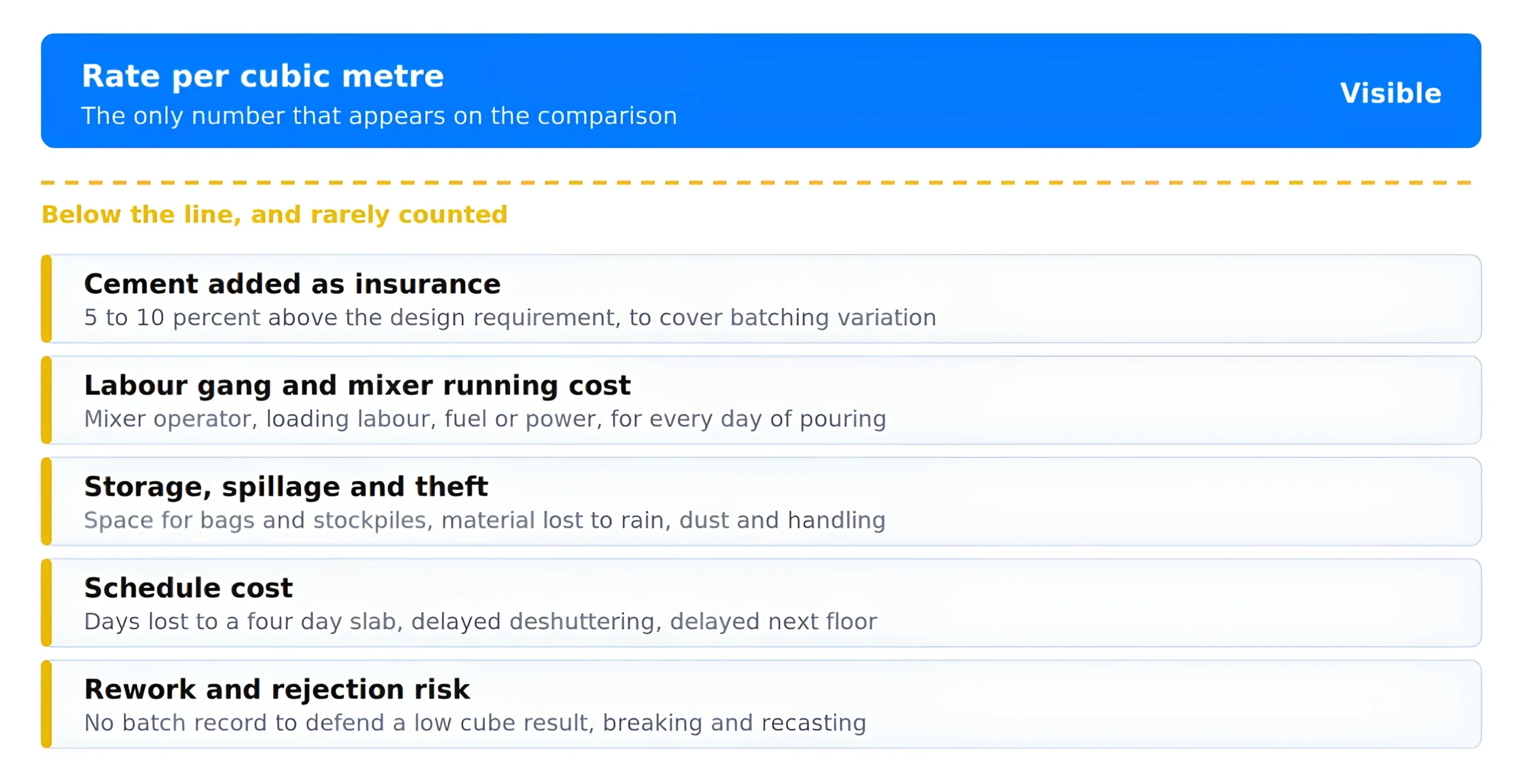
| Cement usage | Usually 5 to 10 percent extra cement is added as a safety margin against variation | Cement content fixed by the mix design, no padding needed |
| Site impact | Needs storage space, water point, labour, and creates dust and spillage | No storage, no stacking, no gang on site, minimal cleanup |
| Records | Rarely documented, hard to defend during audit | Batch slip and cube test reports for every pour |
| Best suited to | Small repairs, plinth work, remote sites, quantities under about 3 cubic metres | Slabs, columns, rafts, roads and any pour where strength has to be proven |
The quote shows one line. The pour costs five.
What site mixing adds to the delivered cost of a cubic metre.
When site mixing is still the right call
Small repairs, plinth beams, boundary walls, remote pockets where a mixer cannot reach, and anything under about three cubic metres. Below that volume the mobilisation does not justify a transit mixer. Above it, and certainly on any load bearing element, RMC is the cheaper decision once the full cost is counted.